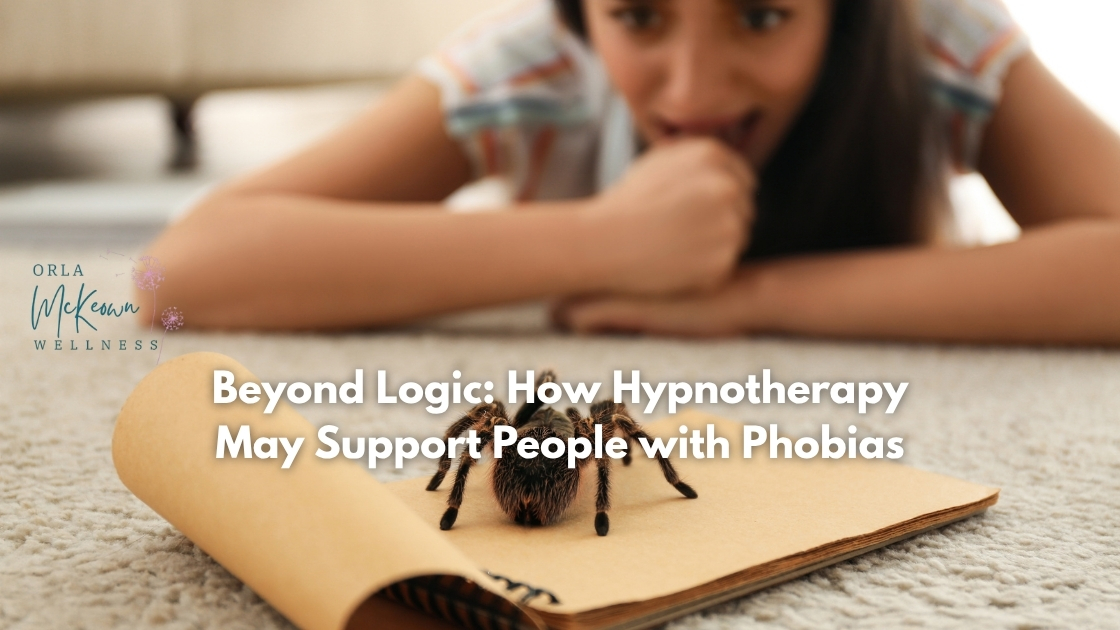

Beyond Logic: How Hypnotherapy May Support People with Phobias
One of the most frustrating aspects of living with a phobia is the gap between what a person knows and what they feel.
A client may understand perfectly well that a lift is safe, that a routine medical procedure is necessary or that air travel is widely used every day. They may have researched the facts, listened to reassurance and repeatedly told themselves that there is nothing to fear.
Yet when they encounter the trigger, their body responds as though danger is immediate.
Heart rate increases. Breathing changes. Muscles tense. Clear thinking becomes difficult. The urge to escape can feel overwhelming.
This is why telling someone to “be rational” rarely resolves a phobia.
As a clinical hypnotherapist, I view phobic responses not as a failure of logic, but as an automatic protective pattern. Hypnotherapy may be useful because it allows us to work with the subconscious associations underlying that pattern.
A phobia is more than a conscious thought
Fear is a necessary human response. It helps us recognise danger and take protective action.
A phobia develops when that response becomes strongly associated with an object, situation or experience, even when the actual level of danger does not match the intensity of the reaction.
People can develop phobias relating to flying, driving, heights, needles, animals, enclosed spaces, medical procedures, public speaking and many other situations.
The conscious mind may understand that the response is disproportionate. However, phobias are often maintained by automatic processes involving memory, emotion, physical sensation and learned association.
That distinction matters professionally.
When we treat a phobia solely as an irrational belief, we risk overlooking the person’s genuine physiological and emotional experience.
The protective intention behind the fear
In therapeutic work, it can be helpful to recognise that the subconscious response is often attempting to protect the person.
The mind may have learned—through direct experience, observation or another association—that a particular trigger means danger.
Once established, this pattern can operate quickly and automatically.
The reaction is therefore not evidence that the person is weak, dramatic or unwilling to change. Their protective system is simply responding according to what it has learned.
The therapeutic objective is not to fight that system.
It is to help it update.
Why avoidance can strengthen a phobia
Avoidance is an understandable response to fear.
When someone avoids a flight, leaves a crowded room or cancels an appointment, their anxiety may reduce immediately. That relief can reinforce the belief that escaping was necessary for safety.
The next encounter may then feel even more threatening.
Over time, avoidance can affect choices around employment, relationships, healthcare, travel and everyday independence.
This creates an important therapeutic challenge. The client needs support to move beyond the established pattern without feeling pushed into an overwhelming confrontation.
Hypnotherapy can offer a gradual and controlled way to begin changing the internal response before the person takes practical steps in everyday life.
What clinical hypnotherapy offers
Hypnotherapy uses guided relaxation and focused attention to support therapeutic work at a subconscious level.
The client is not asleep or unconscious. They remain aware, retain control and cannot be made to act against their wishes.
During a session, the reduced level of external distraction can make it easier to work with imagery, emotional associations, beliefs and automatic responses.
In the context of phobias, hypnotherapy may be used to:
- reduce the emotional intensity attached to a trigger;
- strengthen feelings of calm and control;
- rehearse a more regulated response;
- challenge established subconscious associations;
- build confidence in the person’s ability to cope;
- support gradual movement away from avoidance.
This is not a process of simply repeating positive statements.
Effective clinical work requires an understanding of the client’s specific experience, triggers, protective patterns and desired outcome.
The importance of individual formulation
The same phobia can function differently for different clients.
A person who fears flying may be distressed by turbulence, enclosed spaces, loss of control, physical sensations or a previous experience.
A client with a needle phobia may fear pain, fainting, loss of control or receiving bad news.
Treating every client with an identical script overlooks these important differences.
My approach begins with careful listening.
I want to understand how the fear operates, when it is strongest, what maintains it and how the client would know that meaningful progress had occurred.
This allows the hypnotherapy to be tailored to the person rather than the diagnostic label.
Working without unnecessary overwhelm
Therapeutic change does not require a client to become overwhelmed.
A professional, trauma-aware approach should respect the individual’s pace and capacity for emotional regulation.
Hypnotherapy can allow clients to explore aspects of the feared situation while remaining physically safe and supported. Visualisation and subconscious rehearsal may help the person practise a calmer response before encountering the situation in everyday life.
This can be particularly useful for clients who are not yet ready to approach the trigger directly.
The aim is not avoidance forever, but neither is it forced exposure without adequate preparation.
Safety, choice and collaboration remain central.
Supporting younger clients
Children and teenagers may experience phobias without having the emotional vocabulary to describe them.
Their fear may appear as refusal, anger, tears, sleep difficulties, physical discomfort or repeated reassurance-seeking.
When working with younger clients, rapport is essential. A child should not feel that therapy is another situation in which an adult is demanding answers.
Clinical hypnotherapy can be adapted in an age-appropriate way, often using imagination, stories, relaxation and confidence-building. Depending on the individual, I may also draw on other gentle approaches to support expression and emotional regulation.
The goal is to help the young person feel safer and more capable, not to make them feel ashamed of their response.
Professional boundaries and realistic claims
Hypnotherapy can be a valuable therapeutic approach, but it is important to communicate its role responsibly.
No practitioner can guarantee that a phobia will disappear within a set number of sessions. Outcomes depend on the individual, the nature of the fear, wider emotional factors and the person’s engagement with the process.
Hypnotherapy does not replace appropriate medical, psychiatric or psychological care. A responsible practitioner must recognise when further assessment, collaborative care or onward referral is appropriate.
Professional credibility is strengthened—not weakened—by clear boundaries and realistic expectations.
Moving from automatic fear towards greater choice
The most meaningful change is not always the complete absence of nervousness.
For one client, progress may mean attending an appointment they previously avoided. For another, it may mean boarding a plane while remaining able to regulate their breathing and thoughts. Someone else may simply want the freedom to consider an opportunity without an automatic “no” from fear.
Hypnotherapy may help create more space between the trigger and the response.
Within that space, the client can begin to experience greater choice.
As a clinical hypnotherapist, I find this one of the most valuable aspects of the work. We are not asking the person to deny their feelings or overpower themselves through willpower. We are helping the subconscious mind develop a response that is calmer, more proportionate and more supportive of the life they want to live.
Phobias can feel deeply limiting, but they do not need to be treated as personal failings.
With appropriate, individualised support, it may be possible to change the automatic patterns that keep fear in place.